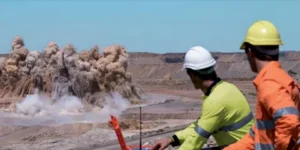

Drill & blast remains the primary method for rock breakage in mining, quarrying and many civil engineering projects. When planned and executed well, good drill & blast design delivers safer operations, better fragmentation, lower downstream processing costs, and improved overall productivity. Poor design, however, increases costs through overbreak, excessive fines, rework, and environmental impact.
At Indo African Explosives Ltd., we work with clients to ensure drill & blast designs meet production goals while controlling cost, vibration, airblast and environmental impact.
What is good drill & blast design? (High-level)
Good drill & blast design is an integrated approach that matches geology, explosives, drilling pattern and operational goals. It is a planning process — not a one-size-fits-all recipe — that balances fragmentation, safety, environmental limits and cost efficiency. Design is always produced and approved by qualified blast engineers.
Key benefits of optimised drill & blast
- Improved fragmentation — reduces crushing and grinding energy, increasing throughput and lowering processing costs.
- Lower overall cost-per-ton — better breakage means fewer secondary breakages and less re-handling.
- Enhanced safety — controlled blasts minimise flyrock, misfires and unexpected vibrations.
- Environmental control — optimised design reduces excessive vibration, airblast and dust.
- Predictability — repeatable results that aid planning, scheduling and resource use.
Principal design considerations (conceptual)
These are the high-level factors a qualified engineer will evaluate when preparing a drill & blast design:
- Geology & Rock Mass Conditions — rock type, fracturing, faults and weathering control how energy is distributed and how rock breaks.
- Production Objectives — required fragmentation size, bench height, and production tonnage inform design trade-offs.
- Hole Layout & Pattern — blasthole spacing, burden and depth are chosen to distribute explosive energy as required (details must be engineered).
- Explosive Type & Loading Method — choice between bulk emulsions, packaged products or cartridge explosives affects confinement and energy delivery.
- Initiation System & Timing — precise timing sequences control energy interaction between holes to shape fragmentation and vibration (electronic/non-electric/electrical systems have different capabilities).
- Environmental & Community Limits — vibration, airblast and dust limits set by regulators and local agreements guide design constraints.
- Operational Constraints — drill rig capacity, hole deviation tolerance, available magazines, transport logistics and weather all influence practical design choices.
- Cost Targets — designs should be cost-aware: optimise for total cost-per-ton, not just immediate explosive cost.
Best practices (non-technical guidance)
- Start with site-specific data. Use geotechnical reports, previous blast records and production targets as inputs.
- Use technical trials responsibly. Pilot blasts and monitored trials (under engineering supervision) help validate assumptions and refine designs.
- Monitor & record every blast. Vibration, airblast, fragmentation and flyrock data create a feedback loop for continuous improvement.
- Collaborate across teams. Mine planners, drill operators, processing engineers and environmental officers should all be involved.
- Prioritise training & competency. Ensure personnel handling explosives and implementing the design are trained and certified.
- Plan for contingencies. Procedures for misfires, weather delays and community notifications should be in place.
- Respect regulations and community agreements. Design must comply with legal limits and community commitments.
Measuring success (what to track)
To judge whether a drill & blast design is working, track measurable KPIs such as:
- Fragmentation distribution (e.g., percent passing certain sizes)
- Downstream crushing/grinding energy consumption
- Re-handling and secondary breakage rates
- Vibration and airblast compliance with limits
- Incidence of safety events (near-misses, misfires, flyrock)
- Cost per ton (total, not just explosive cost)
Role of the explosives supplier (how we add value)
A reputable supplier should do more than deliver products. Services that materially improve outcomes include:
- Technical consultation on product selection and suitability.
- Drill & blast support and collaborative design input.
- On-site initiation and sequencing advice, plus monitoring services (vibration, flyrock, airblast).
- Training for site teams on safe handling and best practices.
- Datasheets, certification and traceability for all product batches.
Indo African Explosives Ltd. provides certified products, drill & blast consultancy, vibration monitoring and tailored training packages to ensure your design objectives are met safely and efficiently.
Safety & compliance reminder
Drill & blast design and execution must always be entrusted to qualified engineers and certified personnel. This article provides high-level guidance only — it intentionally avoids operational specifics. Never attempt to design or execute blasts without the appropriate licences, training, supervisory control and legal approvals.
Quick checklist for managers (one-page)
- Have you engaged a qualified blast engineer? ✔️
- Is there current geological and blast-history data? ✔️
- Are environmental and community limits defined? ✔️
- Is the selected explosive product certified and suitable? ✔️
- Is monitoring equipment and a recording plan in place? ✔️
- Are drill crews and shotfirers trained for the design? ✔️
Conclusion
Optimised drill & blast design is a high-impact lever for improving fragmentation, reducing costs and minimising environmental and community impact. It is the result of disciplined data-driven engineering, close supplier collaboration and continuous improvement through monitoring and feedback.